
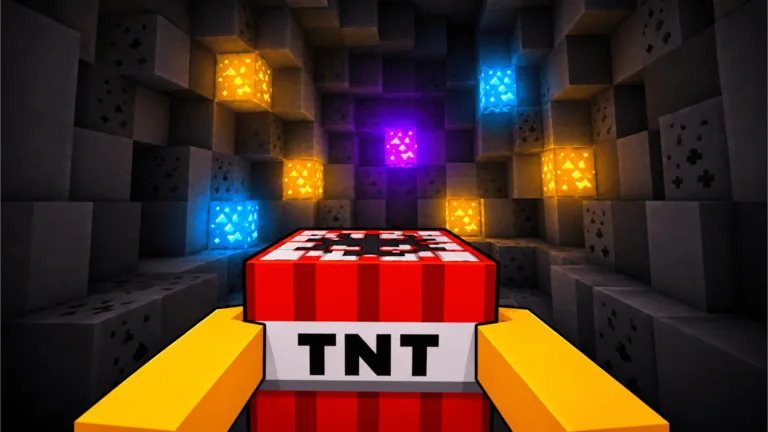
React to the alert, then search methodically
When the game announces that a Secret has spawned, stop blasting at random and turn the mine into a search grid. Scan the walls and newly exposed depth one section at a time. Keep enough TNT ready to reach a suspicious block. Do not leave the server right away. One playthrough showed the alert and a successful find in the same mine.
The 1 TNT Mining secret blocks system is real, but there is no official table of coordinates, guaranteed areas, spawn rates, or rewards. Treat the alert as your trigger and search the current mine first.
A fast Secret block search route
Use a repeatable route instead of crossing your own path:
- Read the spawn message and note the mine you are in.
- Sweep the visible surface and freshly opened cavities.
- Move along one wall in a single direction.
- Blast toward unsearched depth without scattering TNT across the whole mine.
- Collect after each detonation so exposed blocks do not hide behind debris.
- Mark where you turned, then begin the next parallel strip.
Coverage matters more than the number of explosions. Random placements leave plenty of wall untouched. Follow one wall and you will always know which space you have already checked.
Prepare before a Secret spawns
A spawn alert is less useful if you are out of TNT, full on blocks, or too weak to clear the layer efficiently. Before committing to a long server session:
| Preparation | Why it matters |
|---|---|
| Keep TNT available | You can react without returning to refill immediately |
| Maintain collection space | Debris does not end the search early |
| Use a mine you can clear efficiently | Damage does not stall at every wall |
| Learn the route back to the lobby | You can sell and return without losing time |
| Note your starting depth | You can separate searched and unsearched layers |
Deeper mining officially leads to rarer, more valuable blocks in general. That makes depth a sensible part of a search route, but it does not prove that every Secret spawns at the deepest point. Search what the blast opens rather than racing past visible walls.
Damage and placement decisions
Your Damage and TNT should be strong enough for the current material. If a blast barely changes the wall, return to training or use a mine you can clear more consistently. Spending minutes on one resistant layer reduces the amount of space you can inspect during the same session.
Placement also matters. Put TNT where one explosion exposes a clean face or corridor. Avoid dropping every available charge into an already open chamber; dramatic overlap is not the same as useful coverage. After each blast, collect the blocks and look into the new cavity before placing again.
What one Secret find tells us
One playthrough displayed “A secret has spawned” in the Jungle mine. The player searched and found a Spirit Stone. That is a useful example, not a universal map. It shows the alert and search loop, but it does not mean Spirit Stone always appears there or keeps the same value after an update.
If you find a Secret, record the mine, approximate depth, server time, item name, and sell result. Repeated observations are more useful than turning one lucky find into a false rule.
Mistakes that ruin a hunt
- Leaving the mine before checking the current walls after an alert.
- Following a claimed coordinate without confirming the current update.
- Mining in random directions and repeatedly covering the same ground.
- Using a layer your Damage cannot clear at a reasonable pace.
- Treating one reward as the only possible Secret.
- Assuming the paid tracker creates more spawns; its verified description concerns detection.
Build a search grid from blast shapes
Start at a wall edge and place the first charge where the blast will expose a new face. Collect the debris, inspect the opening, then place the next charge just beyond the previous cavity. This creates a chain of visible sections instead of disconnected holes.
When the mine is wide, divide it into three lanes: left wall, center, and right wall. Finish one lane before crossing to another. When the mine is deep, use clear height or color changes as checkpoints. Write down the last checkpoint before returning to sell so you can resume without covering the same ground.
If a wall survives the blast, do not keep stacking charges automatically. Compare your Damage with the layer, train if necessary, and return when one placement produces useful progress. Efficient Secret hunting is mostly about maximizing new wall exposed per trip.
What to do after a find
Collect the Secret before leaving the area, then take a screenshot of the item name and any visible rarity label. If you want to learn its sell value, record the Cash balance immediately before and after selling it separately. Do not mix the Secret into a large haul and then guess its contribution.
Keep the record dated because values and spawn behavior can change. A personal log helps with future hunts, but it should never be presented as a guaranteed global table after only one result.
FAQ
Do Secret blocks exist in +1 TNT Mining?
Yes. The official Secret Tracker pass and captured in-game spawn alert both confirm the system.
Where do Secret blocks spawn?
No fixed location table is verified. Start in the mine active when the alert appears and sweep visible walls plus newly exposed depth in a consistent pattern.
What rewards come from Secret blocks?
A player found a Spirit Stone in one run, but that is not a complete reward table. Read the item name and sell result in your own server.
Do I need Secret Tracker to find one?
The pass reveals Secret blocks through walls. That makes detection easier, but the description does not state that it is required for a Secret to exist or be uncovered.
Does going deeper guarantee a Secret?
No guaranteed depth is published. Deeper layers contain rarer blocks generally, but Secret spawn rules remain separate and should be checked in the current game.