
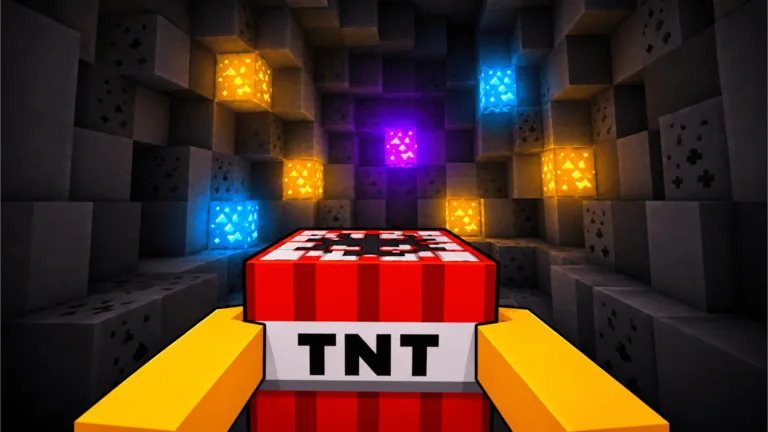
Go deep enough, but no deeper
Rarer blocks become available deeper in the mines, but the best search depth is the deepest section your current Damage and TNT can clear at a practical pace. Blast dense faces, sweep the whole crater, and move deeper only when the present layer stops resisting your normal cycle.
A complete drop table is useful only when the current game publishes it. Names, values, rarity distribution, and depth rules can all move after an update.
Recognize what the game shows you
Captured gameplay displayed rarity labels on discovered blocks, including Legendary and Mythic, plus a Secret spawn notification. It also showed example finds such as Amber, Fossil, Jade, Ancient Tablet, Ruby, and Spirit Stone. These examples confirm that visually and economically distinct finds exist; they do not guarantee a fixed mine, depth, value, or drop chance today.
Use the live label as your decision signal:
| Visible situation | Best response |
|---|---|
| Rare-looking block breaks in one normal cycle | Collect it and continue the route |
| Valuable block survives but visibly weakens | Use controlled overlap if the extra charges are worth it |
| Target barely changes after several blasts | Improve power and return later |
| Secret spawn message appears | Scan the current mine and deeper exposed faces promptly |
| Crater contains scattered bright fragments | Sweep the outer edge before moving on |
Depth is an opportunity, not a guarantee
The official game description connects deeper layers with rarer blocks. It does not promise a rare find on every blast. Think in repeated efficient faces rather than a guaranteed coordinate.
A productive search route follows three rules:
- Work a depth where ordinary material clears quickly.
- Place charges against fresh walls to expose the most new blocks.
- Collect every crater before moving, because a rare fragment left behind earns nothing.
If the deepest section produces tiny craters, move slightly higher. More exposed blocks per minute can create more chances than spending the whole run on one resistant wall.
Match TNT placement to the target
Use broad spacing while searching. This exposes more fresh material per ignition. Switch to controlled overlap only after a worthwhile target is visible and your current power can affect it.
Avoid building a tower of every available charge on an unknown wall. Heavy overlap reduces the new area revealed. A better routine is to place across a dense face, ignite, inspect the result, collect, and then focus only when the blast reveals something worth extra attention.
Balance a rare hunt with Cash progression
Rare blocks are part of the economy, but hunting one stubborn target can slow total earnings. Set a simple exit rule before the run:
- Leave the target after two or three poor blast cycles.
- Sell when the carried TNT supply ends.
- Spend on power when valuable blocks regularly survive.
- Spend on collection range when finds remain outside pickup reach.
- Unlock the next area only when your setup can work there effectively.
These limits keep one stubborn block from swallowing an otherwise profitable run.
Secret is a separate rarity signal
Players can see a “secret has spawned” notification and then search the mine. The Secret Tracker gamepass says it reveals secret blocks through walls, but it does not promise a location or spawn schedule.
Without the pass, react by scanning exposed faces, route edges, and recently opened deeper sections. Do not tell other players that a specific coordinate always works. Server changes and updates can invalidate remembered positions.
Record useful results without inventing a table
You can make a personal route log using only facts you see:
- mine or area used;
- approximate depth or visual landmark;
- visible rarity label;
- number of blast cycles required;
- final Cash change after selling the haul.
After several runs, this reveals which area is productive for your account. It is more useful than copying a universal value list that lacks a checked version date.
Update note
Checked September 15, 2026. Block names, values, rarity labels, locations, and spawn behavior are update-sensitive. Confirm them in the current mine and sell UI.
FAQ
Where do rare blocks spawn in +1 TNT Mining?
The verified rule is that deeper layers contain rarer blocks. No fixed coordinate or complete current distribution is confirmed.
Should I use all my TNT on one rare block?
Only when the target responds to your blasts and its expected value justifies the lost coverage. Leave targets far beyond your power.
What rarity labels have been seen?
Matching gameplay displayed Legendary, Mythic, and Secret signals, but the current live game can revise its rarity set.
Does a Secret block have a guaranteed location?
No guaranteed coordinate is established. React to the live spawn message and search exposed or deeper mine faces.
Is the Secret Tracker required for rare blocks?
No. Its official description says it reveals secret blocks through walls; ordinary rare-block mining still follows the normal blast-and-collect loop.